

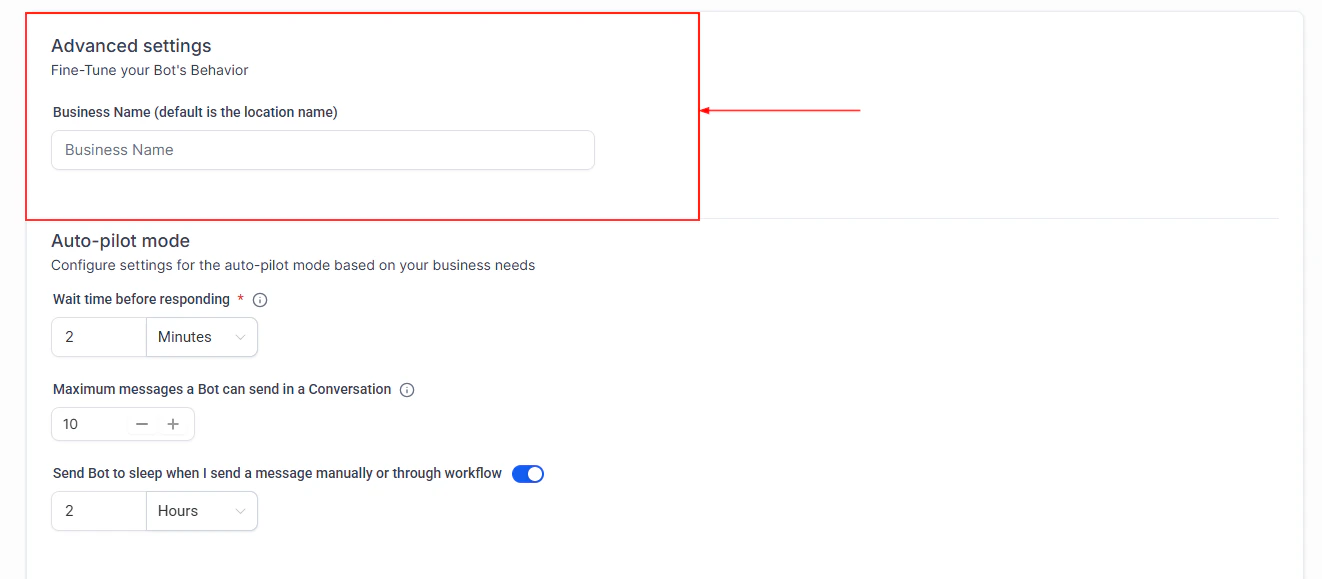
The Conversation AI bot configuration where you write and test your system prompt
Why prompt engineering matters
Your AI agent is only as good as the instructions you give it. Without a clear prompt, even the most powerful language model will:- Hallucinate information it does not have
- Give vague, generic answers that erode customer trust
- Fail to collect the information your business needs
- Miss opportunities to book appointments or qualify leads
You do not need a technical background to write great prompts. If you can write a clear email to a new employee explaining their job, you can write an effective AI prompt.
The 4-part framework
Every high-performing prompt follows the same structure: Role, Task, Guidelines, and Examples. Think of it as an onboarding packet for a new hire — you tell them who they are, what they need to do, what rules to follow, and show them examples of great work.Part 1: Role — define who the AI is
The Role section establishes the AI agent’s identity, personality, and tone of voice. This context shapes every response the agent generates. A good role definition includes:- Business identity — the company name, industry, and what you do
- Agent persona — the agent’s name and character (“You are Sarah, a friendly scheduling assistant for Bright Smiles Dental”)
- Tone of voice — professional, casual, warm, authoritative, empathetic
- Language — what language(s) the agent should use
Part 2: Task — what the AI should accomplish
The Task section defines the agent’s primary objectives. Be explicit about what the agent should do in order of priority. Common tasks include:- Answer questions about your products, services, hours, and pricing
- Book appointments by collecting name, preferred date/time, and service type
- Qualify leads by gathering budget, timeline, and decision-making authority
- Collect contact information such as email, phone number, and company name
- Route conversations to the right team member based on the customer’s need
Part 3: Guidelines — set guardrails and rules
Guidelines are the rules your agent must follow. They prevent the agent from going off-script, sharing inaccurate information, or behaving in ways that could harm your business. Effective guidelines cover:- What NOT to do — “Never provide medical advice,” “Do not discuss competitor pricing,” “Never make up information”
- Knowledge boundaries — “Only answer questions using the information in your knowledge base. If you do not know the answer, say so.”
- Off-topic handling — “If the customer asks about something unrelated to our services, politely redirect the conversation.”
- Escalation rules — “If the customer asks to speak with a human, immediately transfer the conversation to a live agent.”
- Compliance rules — “Never ask for credit card numbers, social security numbers, or other sensitive information in the chat.”
Part 4: Examples — show ideal interactions
Examples are the most underrated part of prompt engineering. Showing the AI what a great conversation looks like is often more effective than writing dozens of rules. Include 2-3 examples that cover your most common scenarios:Example interactions
How context and prompt length affect quality
There is a balance between giving enough detail and keeping your prompt manageable. Here are the key principles:More context is usually better — up to a point
- Specific business details (hours, services, pricing tiers) help the agent give accurate answers
- Detailed examples reduce ambiguity and improve consistency
- Clear escalation paths prevent the agent from getting stuck
But overly long prompts can cause problems
- Contradictory instructions buried deep in a long prompt get ignored or cause unpredictable behavior
- Redundant instructions waste context space without improving quality
- Extremely long prompts can dilute the priority of your most important rules
The sweet spot
For most businesses, a well-structured prompt is between 300 and 800 words. Your prompt should be long enough to cover your core scenarios and short enough that every sentence earns its place.If your prompt exceeds 1,000 words, consider moving detailed product information and FAQs into your Knowledge Base instead. The knowledge base is designed to hold large volumes of reference material that the agent can search through as needed.
Quick-start template
Copy this template and fill in the bracketed sections to create your first prompt:Prompt template
Prompt engineering across HoopAI
The 4-part framework applies whether you are writing prompts for Conversation AI chatbots or Voice AI phone agents — but each channel has unique considerations. Dive into the detailed guides below to learn channel-specific best practices.Conversation AI prompts
Step-by-step guide for crafting chat prompts across SMS, web chat, and social channels
Voice AI prompts
Write natural, effective prompts for AI phone agents that handle real calls
Advanced techniques
Multi-step prompting, conditional logic, tone calibration, and more
Common mistakes
The top 10 prompt mistakes and how to fix them with before-and-after examples
Optimization and testing
Systematic methods to test, measure, and improve your prompts over time
Knowledge base
Train your AI agents with custom data sources for accurate, on-brand answers
Next steps
Writing prompts for Conversation AI
Apply the 4-part framework to your Conversation AI chatbot with channel-specific tips
Writing prompts for Voice AI
Adapt the framework for natural-sounding phone conversations
Set up Conversation AI
Create your first Conversation AI bot and configure its channels and settings
Configure bot settings
Assign channels, set bot status, and manage primary vs. non-primary bots