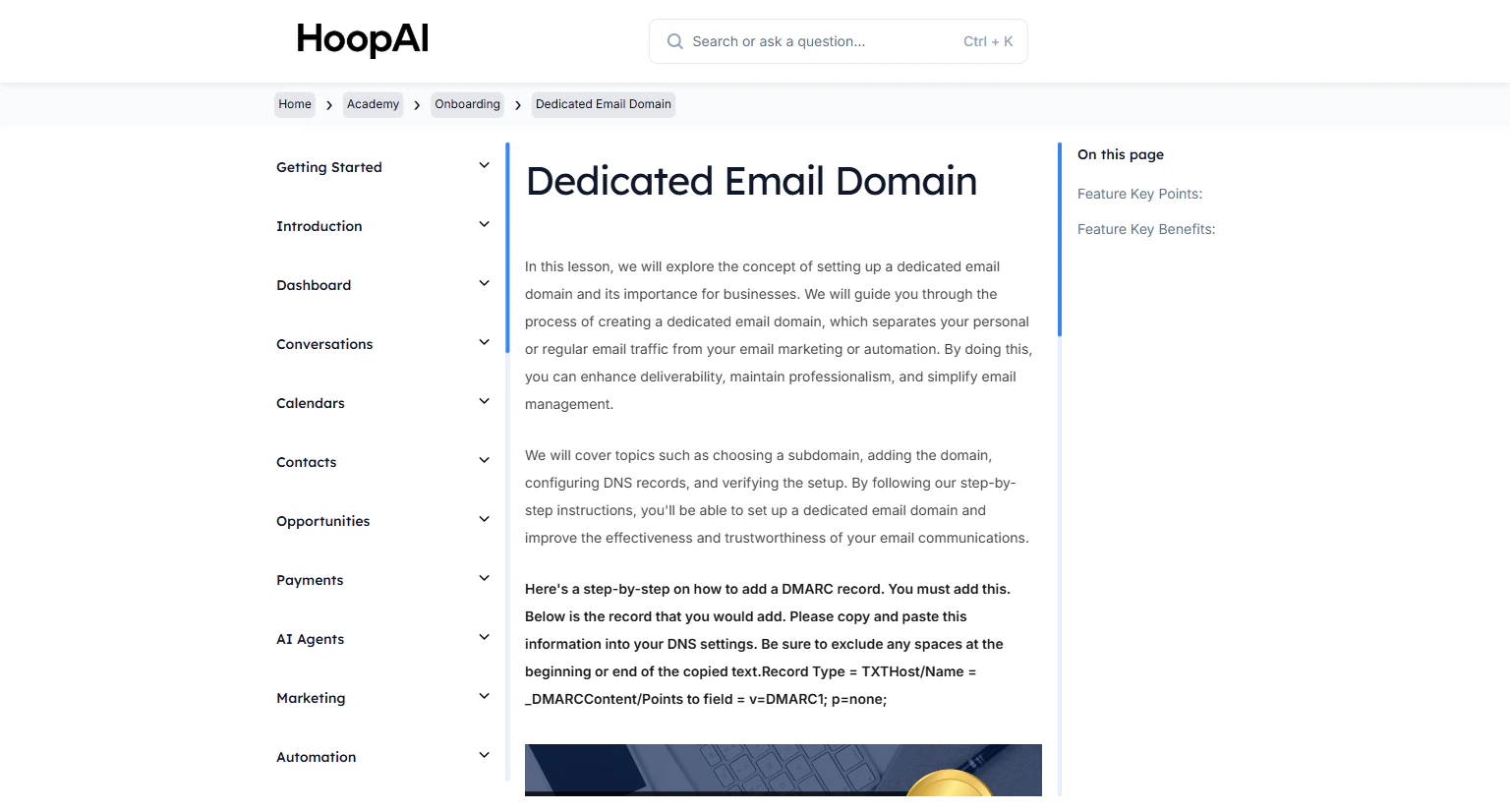
Step-by-step guide to setting up a dedicated email sending domain in the HoopAI Platform to improve deliverability and professionalism.
Setting up a dedicated email domain separates your personal email traffic from your marketing and automation emails. This enhances deliverability, maintains professionalism, and simplifies email management across the HoopAI Platform.
The Dedicated Email Domain lesson in the HoopAI Academy
Sending marketing emails from your main domain can damage its reputation and hurt deliverability. A dedicated subdomain keeps your primary domain protected and your marketing emails landing in inboxes — not spam folders.
You must add a DMARC record to your DNS settings. Copy and paste the following exactly, with no leading or trailing spaces:
In the HoopAI Platform, go to Settings in the left sidebar. Under Email, select Email Services or Dedicated Domain.
Navigate to Settings then Email Services to begin
2
Choose a subdomain
Select a subdomain to use for sending — for example, mail.yourbusiness.com or send.yourbusiness.com. Using a subdomain protects your main domain’s sender reputation.
Use a short, professional subdomain like mail, send, or news. Avoid using your root domain (e.g., yourbusiness.com) for sending.
3
Add the domain
Enter your chosen subdomain in the domain field and click Add Domain. The platform will generate the DNS records you need to add.
Adding your subdomain to the HoopAI Platform
4
Configure DNS records
Log in to your domain registrar and add each record the platform provides. These typically include:
CNAME records for DKIM signing
TXT records for domain verification
TXT record for DMARC (see warning above)
Add each record exactly as shown — spacing and punctuation matter.
5
Add your DMARC record
In your DNS settings, add a new TXT record:
Host/Name:_DMARC
Value:v=DMARC1; p=none;
This is required for email authentication compliance and cannot be skipped.
Adding DNS records at your domain registrar
6
Verify the setup
Return to the HoopAI Platform and click Verify or Check DNS. DNS propagation can take up to 24–48 hours. Once verified, your dedicated domain will show as active and ready to use.
If verification fails immediately, wait a few hours before trying again. DNS propagation times vary by registrar.
Sending marketing emails from your main domain can negatively impact its reputation and deliverability. A dedicated subdomain separates email marketing traffic from regular business communications, protecting your primary domain’s sender reputation.
What DNS records are required
You will need DKIM (DomainKeys Identified Mail) records, SPF (Sender Policy Framework) records, and a DMARC policy record. The HoopAI Platform generates the specific values for your account automatically.
How long DNS propagation takes
DNS changes typically propagate within a few hours but can take up to 48 hours. If verification fails immediately, wait and try again before contacting support.