> ## Documentation Index
> Fetch the complete documentation index at: https://help.hoopai.com/llms.txt
> Use this file to discover all available pages before exploring further.
# Associations
> Link contacts to other contacts, opportunities, companies, and custom objects using named association labels in the HoopAI Platform.
Associations let you create explicit, named relationships between a contact and other records in the HoopAI Platform — such as opportunities, companies, other contacts, or custom objects. Unlike simple lookups or field references, associations carry labels that describe the nature of the relationship, giving your team rich relational context directly on the contact record.
***
## How associations work
An association links two objects together with a label. The label describes the relationship from each side. For example:
* A contact associated with a company as **"Employee of"** — the company sees the contact as **"Employs"**
* A contact associated with another contact as **"Spouse of"** — the linked contact sees the relationship as **"Spouse of"**
* A contact associated with an opportunity as **"Decision maker"** — the opportunity sees the contact as **"Decision maker for"**
Each direction of the association can have its own label. Up to 10 association labels can be applied between any two specific records.
***
## Viewing associations on a contact record
Navigate to **Contacts > Smart Lists** and click the contact's name.
In the right-side information panel, click the **Associations** tab. All linked records are shown as cards, grouped by object type (Contacts, Opportunities, Companies, Custom Objects).
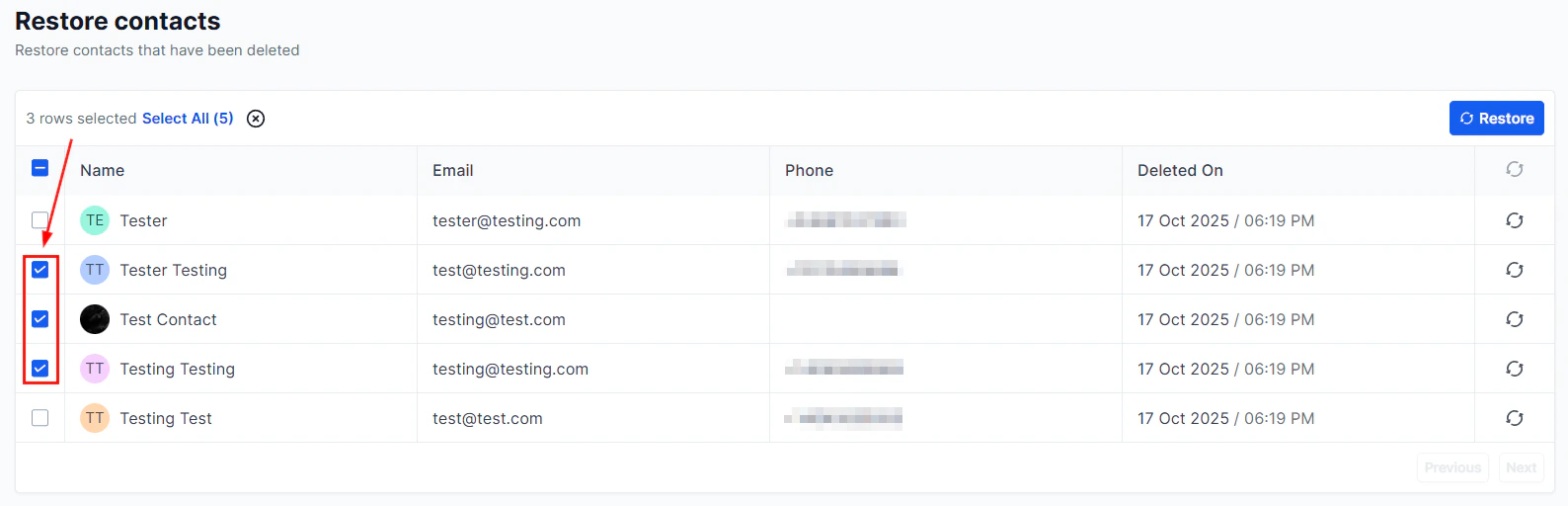 Each association card shows:
* The linked record's name
* The association label applied to the relationship
* A quick-link to open the linked record
***
## Adding an association
In the contact record's right panel, click **Associations**, then click **+ Add**.
A dialog appears with two options:
* **Create New** — opens a form to create a new record (contact, opportunity, or custom object) that will be immediately linked to this contact
* **Add Existing** — search for and link an existing record that already exists in the system
Choose what you are linking to: **Contact**, **Opportunity**, **Company**, or any available **Custom Object**.
Choose the appropriate label from the dropdown to describe the relationship. The available labels depend on which association labels have been configured for that object type in Association Settings.
Click **Save** or **Link** to create the association. The linked record appears immediately in the Associations tab.
Each association card shows:
* The linked record's name
* The association label applied to the relationship
* A quick-link to open the linked record
***
## Adding an association
In the contact record's right panel, click **Associations**, then click **+ Add**.
A dialog appears with two options:
* **Create New** — opens a form to create a new record (contact, opportunity, or custom object) that will be immediately linked to this contact
* **Add Existing** — search for and link an existing record that already exists in the system
Choose what you are linking to: **Contact**, **Opportunity**, **Company**, or any available **Custom Object**.
Choose the appropriate label from the dropdown to describe the relationship. The available labels depend on which association labels have been configured for that object type in Association Settings.
Click **Save** or **Link** to create the association. The linked record appears immediately in the Associations tab.
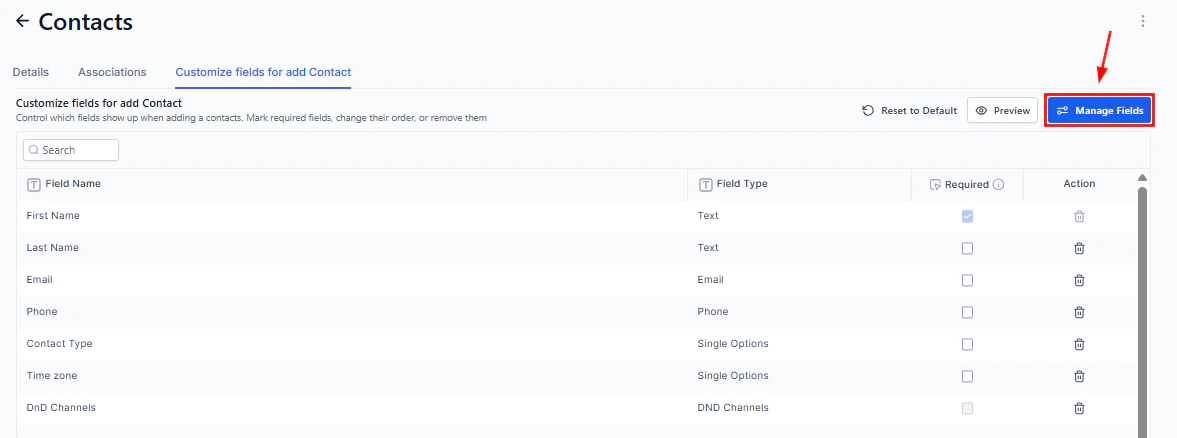 If the label you need is not available in the dropdown, open **Manage Associations** to add new labels or update existing ones.
***
## Removing an association
In the contact record, click the **Associations** tab.
On the association card, click the **X** or the unlink icon to remove the relationship. This removes only the association — neither record is deleted.
***
## Managing association labels
If the label you need is not available in the dropdown, open **Manage Associations** to add new labels or update existing ones.
***
## Removing an association
In the contact record, click the **Associations** tab.
On the association card, click the **X** or the unlink icon to remove the relationship. This removes only the association — neither record is deleted.
***
## Managing association labels
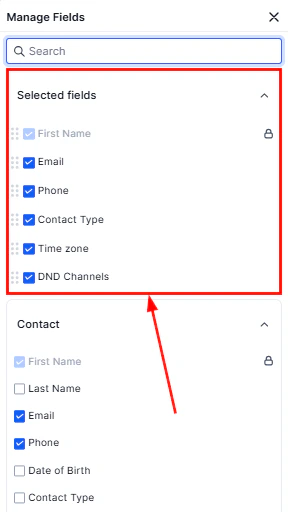 Association labels define what types of relationships are possible between objects. You can create and customise labels in Association Settings.
In the Associations tab of any contact record, click **Manage Associations** — or navigate to **Settings > Objects > Associations**.
Choose the two object types you want to define a relationship between, for example Contact → Contact or Contact → Opportunity.
Click **+ Add Label**. Enter the label name for each direction of the relationship. For example:
* Label from Contact A to Contact B: "Reports to"
* Label from Contact B back to Contact A: "Manages"
Click **Save**. The new label is immediately available when adding associations between those object types.
***
## Association types and use cases
Link family members, business partners, or referral relationships. Examples: "Referred by", "Spouse of", "Reports to", "Referred to".
Define each contact's role in a deal. Examples: "Decision maker", "Champion", "Gatekeeper", "Technical evaluator".
Document employment and business relationships. Examples: "Employee of", "Contractor for", "Director of".
Link contacts to any custom data structure you have created — vehicles, properties, projects, events, or subscriptions.
***
## Associations in automations
Workflow conditions and filters can reference association data. For example:
* **Trigger** — when an opportunity changes stage, notify all contacts associated as "Decision maker"
* **Filter** — run a workflow only if a contact is associated with a company of a certain type
This lets you create relationship-aware automation that reflects the real-world structure of your business relationships.
***
## Custom labels for associations
Beyond the default association labels, you can create custom labels that match your business terminology:
Navigate to **Settings > Objects > Associations** or click **Manage Associations** from any contact's Associations tab.
Choose the two object types (e.g., Contact to Contact, Contact to Opportunity).
Click **+ Add Label** and enter descriptive names for both directions of the relationship. Examples:
* "Referred by" / "Referred to"
* "Parent of" / "Child of"
* "Landlord of" / "Tenant of"
* "Primary contact for" / "Served by"
Save the label. It is immediately available when creating new associations.
Custom labels help your team understand relationships at a glance and can be referenced in workflow conditions for relationship-aware automation.
Create labels that describe both directions clearly. For example, "Reports to" / "Manages" is clearer than "Related to" / "Related to" — directional labels eliminate ambiguity when viewing associations from either side.
***
## Frequently asked questions
There is no hard limit on the total number of associations a contact can have. However, between any two specific records, a maximum of 10 association labels can be applied simultaneously.
Yes. In Advanced Filters, you can filter contacts by their associated records — for example, "Show all contacts who are associated with Company X" or "Show all contacts with at least one Opportunity association."
Yes. If an associated record is deleted, the association link from this contact is also removed automatically.
Association creation during CSV imports is limited. For complex relational data, it is recommended to create associations manually or via the API after importing the base contact records.
Association labels define what types of relationships are possible between objects. You can create and customise labels in Association Settings.
In the Associations tab of any contact record, click **Manage Associations** — or navigate to **Settings > Objects > Associations**.
Choose the two object types you want to define a relationship between, for example Contact → Contact or Contact → Opportunity.
Click **+ Add Label**. Enter the label name for each direction of the relationship. For example:
* Label from Contact A to Contact B: "Reports to"
* Label from Contact B back to Contact A: "Manages"
Click **Save**. The new label is immediately available when adding associations between those object types.
***
## Association types and use cases
Link family members, business partners, or referral relationships. Examples: "Referred by", "Spouse of", "Reports to", "Referred to".
Define each contact's role in a deal. Examples: "Decision maker", "Champion", "Gatekeeper", "Technical evaluator".
Document employment and business relationships. Examples: "Employee of", "Contractor for", "Director of".
Link contacts to any custom data structure you have created — vehicles, properties, projects, events, or subscriptions.
***
## Associations in automations
Workflow conditions and filters can reference association data. For example:
* **Trigger** — when an opportunity changes stage, notify all contacts associated as "Decision maker"
* **Filter** — run a workflow only if a contact is associated with a company of a certain type
This lets you create relationship-aware automation that reflects the real-world structure of your business relationships.
***
## Custom labels for associations
Beyond the default association labels, you can create custom labels that match your business terminology:
Navigate to **Settings > Objects > Associations** or click **Manage Associations** from any contact's Associations tab.
Choose the two object types (e.g., Contact to Contact, Contact to Opportunity).
Click **+ Add Label** and enter descriptive names for both directions of the relationship. Examples:
* "Referred by" / "Referred to"
* "Parent of" / "Child of"
* "Landlord of" / "Tenant of"
* "Primary contact for" / "Served by"
Save the label. It is immediately available when creating new associations.
Custom labels help your team understand relationships at a glance and can be referenced in workflow conditions for relationship-aware automation.
Create labels that describe both directions clearly. For example, "Reports to" / "Manages" is clearer than "Related to" / "Related to" — directional labels eliminate ambiguity when viewing associations from either side.
***
## Frequently asked questions
There is no hard limit on the total number of associations a contact can have. However, between any two specific records, a maximum of 10 association labels can be applied simultaneously.
Yes. In Advanced Filters, you can filter contacts by their associated records — for example, "Show all contacts who are associated with Company X" or "Show all contacts with at least one Opportunity association."
Yes. If an associated record is deleted, the association link from this contact is also removed automatically.
Association creation during CSV imports is limited. For complex relational data, it is recommended to create associations manually or via the API after importing the base contact records.